WEEKLY ASTRO BOY MAGAZINE
Circa 2009 -2010
‘WEEKLY ASTRO BOY MAGAZINE’ was part of the project that aimed to promote and spread TEZUKA MANGA and Japanese Manga culture around the world
Content is from the site's 2009 -2010 archived pages.

Free Version
Now on sale at App Store
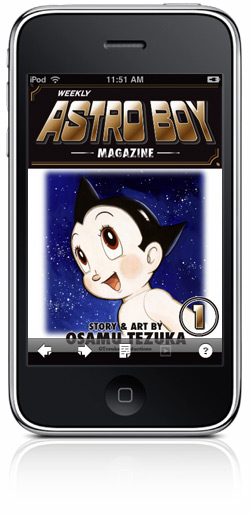
'ASTRO BOY MAGAZINE' will allow you to take the Tezuka Manga with you,wherever you go!
This Free version of WEEKLY ASTRO BOY MAGAZINE will be publishing weekly almost 100 pages as one volume.
One volume of the 'WEEKLY ASTRO BOY MAGAZINE', consisting of almost a hundred pages, will be published weekly.
The first volume includes ‘ASTRO BOY’, the most popular of Osamu Tezuka’s MANGA, as well as ‘PHOENIX’, ‘BLACK JACK’ and more.
The cover page depicts ‘ASTRO BOY’. The first volume is free, and each volume after that will be on sale for 0.99$ per week/one volume.
- FEATURES:
- This is a free version, you will get vol.1 and more volumes will be publishing each week continually.
- WEEKLY ASTRO BOY MAGAZINE vol.1
- -Contents-
ASTROBOY
PHOENIX
DORORO
BLACK JACK
- REQUIREMENTS:
- Compatible iPhone and iPod Touch
- Requires iPhoneOS 3.1 or later
- LANGUAGES:
- English, Japanese
- Available iTunes Store:
- United States,Canada,Japan,
United Kingdom,Singapore,Philippines,Indonesia,
Malaysia,Australia,New Zealand
Complete Version
Now on sale at App Store
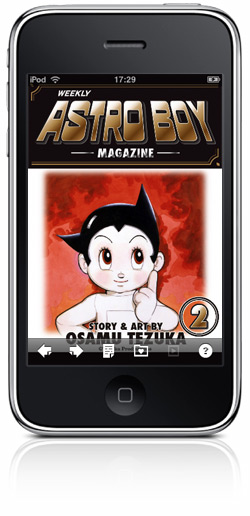
'ASTRO BOY MAGAZINE-Weekly' will allow you to take the Tezuka Manga with you,wherever you go!
This Full vesion of WEEKLY ASTRO BOY MAGAZINE will be publishing weekly almost 100 pages as one volume.
One volume of the 'WEEKLY ASTRO BOY MAGAZINE', consisting of almost a hundred pages, will be published weekly.
The first volume includes ‘ASTRO BOY’, the most popular of Osamu Tezuka’s MANGA, as well as ‘PHOENIX’, ‘BLACK JACK’ and more.
The cover page depicts ‘ASTRO BOY’. The first volume is free, and each volume after that will be on sale for 0.99$ per week/one volume.
- FEATURES:
- In this complete vesion of 'WEEKLY ASTRO BOY MAGAZINE',you will get vol.1 and vol.2,and more volumes will be publishing each week continually.
- WEEKLY ASTRO BOY MAGAZINE vol.1
- -Contents-
ASTROBOY
PHOENIX
DORORO
BLACK JACK - WEEKLY ASTRO BOY MAGAZINE vol.2
- -Contents-
ASTROBOY
BUDDHA
BLACK JACK
- REQUIREMENTS:
- Compatible iPhone and iPod Touch
- Requires iPhoneOS 3.1or later
- LANGUAGES:
- English, Japanese
- Available iTunes Store:
- United States,Canada,Japan,
United Kingdom,Singapore,Philippines,Indonesia,
Malaysia,Australia,New Zealand
-Comment from Frederik L. Schodt
It’s a Brand New World!

Osamu Tezuka is called the manga no kamisama, or “God of Manga,” for good reason. He was a master artist and story-teller who made “comic books” a far more dynamic medium of expression. The global popularity of manga and anime today rests in large part on the foundation he created.

I’ve always hoped more people could enjoy Tezuka’s manga, but until recently there have been many obstacles. Tezuka’s works have been hard to read without an understanding of Japanese and hard to obtain outside of Japan. While many are now being translated and published in other countries, true fans in and out of Japan have also always faced the problem of space. Tezuka specialized in long stories, and his entire collection spans over 400 paperback volumes.

With this wonderful new service we can now enjoy reading classics by the master manga artist on our mobile devices. We can read them any time of day, all over the world, any place—on the plane, at the bus stop, even under the covers at night—without needing big bookshelves or wheelbarrows to cart them around. On my own iPhone, I found myself quickly immersed in old favorites in no time at all, enjoying them all in a brand new way.
* Frederik L. Schodt, author of The Astro Boy Essays: Osamu Tezuka, Mighty Atom, and the Manga/Anime Revolution.
+++
My take: Often considered the Japanese equivalent to Walt Disney, Osamu Tezuka was an extraordinary artist. His animated version of Astro Boy in 1963 created the first successful model for animation production in Japan. The animated films that have since been created in Japan are still some of the most visually breathtaking. Even at a young age my son was a fan of manga. I remember our first Kaanapali waterfront rental in Maui. It was the first of many over the years. Our son had just turned twelve and liked to spend all his time drawing his own manga characters and creating convoluted adventure stories about them. Tezuka was an idol and of course our son had the Astro Boy magazine app on his phone. One evening, as the sun set over Kaanapali, he showed me a sketch of a character adorned with intricate sterling silver rings, each bearing symbols reminiscent of our adventures in Maui. The shimmering rings mirrored the glistening waters of the Pacific and held stories of the tropical fish and turtles we encountered during our snorkeling expeditions. The rings became central artifacts in his manga tales, imbuing the wearers with powers inspired by the vibrant marine life of Maui. The three mile beach stretching on either side of our Kaanapali condo became the backdrop for many of his stories, with the sterling silver rings playing a crucial role in the narrative. Years have passed, and our son's passion for art and manga has only grown stronger. Recently, he was accepted at the Rhode Island School of Design where he plans to major in film/animation, continuing to weave the tales of sterling silver rings and their mystical powers. His journey, greatly inspired by Tezuka, is a testament to the indelible mark that art leaves on young minds. We'll forever be grateful to Tezuka for lighting that spark in our son.
The Latest Volume Information
- WEEKLY ASTRO BOY MAGAZINE vol.18
March 17, 2010 - -Contents- ASTRO BOY, BUDDHA, PHOENIX, BLACK JACK
- WEEKLY ASTRO BOY MAGAZINE vol.19
March 24, 2010 - -Contents- ASTRO BOY, BUDDHA, ADOLF, BLACK JACK
- WEEKLY ASTRO BOY MAGAZINE vol.20
March 31, 2010 - -Contents- ASTRO BOY, BUDDHA, DORORO, BLACK JACK
- WEEKLY ASTRO BOY MAGAZINE vol.21
April 7, 2010 - -Contents- ASTRO BOY, BUDDHA, PHOENIX, BLACK JACK
- WEEKLY ASTRO BOY MAGAZINE vol.22
April 14, 2010 - -Contents- ASTRO BOY, BUDDHA, ADOLF, BLACK JACK
How to Read?
- -What is Koma Animation?
- This KOMA-Animation moving
Manga Viewer is made for iPhone and iPod touch.
This lead you to new style of reading Manga on iPhone and iPod Touch.
Of Course,you can read each pages by Flick.
- -How to Stock it?
- Once you delete the Volume that you have bought,you can download again form the Server for free.
- -How to Buy?
- You will buy on iTunes App Store!
Each volume will be on sale 0.99$ per weekly/one volume.
About ‘WEEKLY ASTRO BOY MAGAZINE’
- -Why is the ‘WEEKLY ASTRO BOY MAGAZINE’ a weekly?
- Tezuka Osamu Manga consists of 150,000 pages, 700 titles, and has been translated and published all around the world.
In order to allow as many people to enjoy as many productions as possible, we have decided to deliver "weekly multi-productions" in serial form. We look forward to creating more fans who will be facinated by Tezuka Osamu Manga.
- -Why iPhone?
- Because its market and distribution scheme is highly developed and ahead of its competitors.
- -About production delivery schedule for ‘WEEKLY ASTRO BOY MAGAZINE’
- The translated version has already been published and those productions that have a proven track record in the market will be delivered in order of precedence.
The production immediate schedule includes the delivery of 100 pages a week, 30,000 pages in all, taking 3 years to complete.
- -About countries and areas where ‘WEEKLY ASTRO BOY MAGAZINE’ will be delivered.
- Starting with delivery of the English version to the USA in the autumn of 2009, delivery will be made possible in Japan, continuing with the French and the English version to the EU in the summer of 2010, and the Chinese, Italian and Spanish versions after that.
- -About the devices that ‘WEEKLY ASTRO BOY MAGAZINE’will be delivered in the future.
- There are no "rules" when it comes to enjoing Manga. We plan to seek and develop various methods that enable the enjoyment of Manga.
WHO WAS OSAMU TEZUKA?
Osamu Tezuka created a revolution in comics and animation.
Born in 1928 in Toyonaka, in Osaka,Japan,he was reised in the nearby city of Takarazuka.
From a very early age he loved to draw (and love to collect insects so much that he later incorportated the ideogram for ‘insect’ into his first name as a pen-name.)
When he was eighteen,and enrolled in university as medical student,he made his debut as a cartoonist with a four panel newspaper comic strip titled ‘Ma-chan’s diary’.
Not too long thereafter paperbaxk compilations of his longer stories,with titles as ‘New Treasure Island’,‘Lost world’and ‘Next World’
In doing so he brought an unusually creative and educated mind to both fields.
In comics,in particular,he pionaeered long narratives of hundereds,even thousand of pages,bringing ‘cinematic’ art styles and novelistic plots to the medium.
By 1950 he had finally established his position as the leading comics artist of his day when he serialized his now-classic work,‘Jungle Emperor’(also known as ‘Kimba the White Lion’) in the monthly magazined,‘Manga Shonen’.
Then,in 1952 he began serializing ‘Mighty Atom’,in the young boy’s monthly Shonen.
Mighty Atom,which later became known to Amereicans as ‘ASTROBOY’,cotinued until 1968,becaming one of Tezuka’s most pupular and famous works.
Tezuka did not stop with Atom,however.
He began turning out one hit after another,with ‘Princess Night’in 1953,‘Ambassador Magma’ and ‘W3’ (‘Amazing 3’)in 1965.
‘Vampire’ in 1966,and ‘Dororo’ in 1967.
In 1967 he also began drawing waht he called his ‘life work‘--‘The Phoenix’ and creating comics targeted at a more abult audience.
Remarkably,Tezuka continued creating comics with powerful,original themas throughout his long career.
Some of his best known later works,include Ode to Kirihito,1970,A History of Birdman,1971,A Hundred Tales,1971,Ayako,1972,Black Jack and Buddha,1973,MW,1976,A Tree in the Sun 1981,tell Adolph,1983,Ludiwig B.,1987,and Neo Fausto,1988.
Tezuka continued creating and drwaing comics until he died on Feb 9th in 1989.
Asahi newspaper explained the coontribution of this this great artist as follows;
Foreign visitors to Japan often find it difficult to understand why Japanese people like comics so much.
For example,they often reportedly find it odd ti see grown men and women engrossed in weekly comics magazine on the trains during commute hours.One explanations for the popularity of comics in Japan,however,is that Japan and Osamu Tezuka,the postwar explosion in comics in Japan would have been in conceivable.
-Policy-Tezuka Manga to all over the world!
As the environment surrounding network infrastructure and information technology continue to change, Tezuka Produtions’ publishng division has created a brand new style of enjoying MANGA. The main project is the ’Osamu Tezuka Magazine branding project, which carries the themes “reading, seeing, chatting, creating”. These services have already been put in motion this past year, commemorating the 80th anniversary of OSAMU TEZUKA.
PRESS
Weekly Astro Boy Magazine brings Tezuka to the iPhone
2009-10-21 Brad Rice
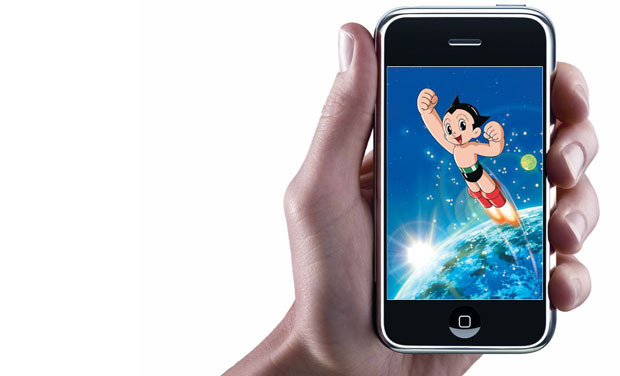
Looking for some manga on the go? How about Osamu Tezuka's Astro Boy? I bet you were expecting me to say Bleach or Lucky Star, weren't you?
Well, thanks to the people at Tezuka Productions and the eminent Fred Schodt, we'll be getting a new app in the iPhone store enttiled "Weekly Astro Boy Magazine," which will feature chapters of Phoenix, Black Jack and Astro Boy. The first volume will be free, followed by $0.99 per chapter of the magazine.
So not only are we getting manga on the go, but essentially three Tezuka classics at once! Hot damn, this is exciting. While I'm not one of the many legion of iPhone users (although I am looking forward to the Motorola Droid!), I'd plop down my money in an instant on this.
They've gone ahead and launched a site for the app, but it's still just a teaser at the moment. I am expecting all you iPhone people to buy this. I will be severely disappointed when I check your phones and see it's not there.
English Language Osamu Tezuka Digital Library Coming to iPad this July, Android Planned
Exciting New Venue For the "God of Manga's" Work
Scott Green
July 04, 2011
A Foreign Correspondents' Club of Japan notice for a luncheon with Tezuka Productions' Takayuki Matsutani, f SOBA Project's Kazushi Inui and translator Frederik L. Schodt note plans to bring Osamu Tezuka's manga such as Astro Boy and Black Jack to English reading iPad users this July.
Beginning in this July, the library will be offered to iPad users in the English-speaking world, allowing subscribers to carry around a large digitalized archive of translated volumes of Tezuka's work. The library will expand to Android PC tablets later this year, with services provided in French, Italian, Chinese, Spanish, Portuguese and Korean also planned.
In addition to digital manga, the application also includes video versions with voiceovers from top actors and special effects for added entertainment called "Motion Manga" (with English Subtitles).
Tezuka manga, including Astro Boy, Black Jack, Phoenix, Dororo and Adolf has been serialized for the iPhone via the weekly Astro Boy Magazine app.
Thanks to All
- -Tezuka Productions
- -U.S. Publishers
- DARKHORSE Comics (Oregon)
- VERTICAL-Inc. (New York)
- VIZ Media,LLC (San Francisco)
- -Frederik L. Schodt
- -Credit of Each Books
- ASTRO BOY(The first publishing was in 1951 in Japan)
English-language version produced by DRAK HORSE COMICS, Inc.
Translation/Frederik L. Shodt
Lettering and Retouch/Digital Chameleon - BLACK JACK(The first publishing was in 1973 in Japan)
English-language version produced by Verticla, Inc.
Translation/Camellia Nieh - BUDDHA(The first publishing was in 1972 in Japan)
English-language version produced by Vertical, Inc.
Translation/Yuji Oniki - DORORO(The first publishing was in 1967 in Japan)
English-language version produced by Vertical, Inc.
Translation/Down T. Laabs - PHOENIX(The first publishing was in 1967 in Japan)
English-language version produced by VIZ Media, LLC
Translation/DADAKI Jared,Cook,Sakamoto,and Frederik L. Shodt - ADOLF(The first publishing was in 1983 in Japan)
English-language version produced by VIZ Media, LLC
Translation/Yuji Oniki
Touch-Up Art&Lettering;/Yoshiyuki Higuchi
- -Weekly ASTROBOY MAGAZINE
iPhone Digital Publisher - D-Arc, Inc
- -Chinese-language version

More Background On AstroBoyMagazine.com
AstroBoyMagazine.com was the official website supporting Weekly Astro Boy Magazine, a digital manga publishing project active primarily between 2009 and 2010. The site documented an ambitious effort to bring classic Japanese manga—most notably the works of Osamu Tezuka—to a global audience through emerging smartphone technology. At a time when digital publishing was still experimental and mobile reading platforms were in their infancy, AstroBoyMagazine.com represented a forward-looking convergence of heritage media, international licensing, and app-based distribution.
Rather than functioning as a traditional magazine website filled with daily updates or editorial commentary, AstroBoyMagazine.com served as a centralized informational hub. Its primary role was to explain the concept, features, release schedule, and cultural goals of the Weekly Astro Boy Magazine app, while also contextualizing the broader importance of Tezuka’s work for readers who may have been encountering it for the first time.
Today, the site remains accessible primarily through web archives, where it stands as an important historical document reflecting early digital manga strategies and the globalization of Japanese pop culture.
Ownership and Project Leadership
AstroBoyMagazine.com was closely tied to Tezuka Productions, the organization established to manage the intellectual property and artistic legacy of Osamu Tezuka. Tezuka Productions has long overseen licensing, translation, and international publication of Tezuka’s extensive catalog, which includes thousands of individual works and tens of thousands of pages of original content.
The digital publishing and app delivery for Weekly Astro Boy Magazine were handled by a Japanese mobile content publisher responsible for adapting the material to early smartphone environments. This partnership brought together rights holders, translators, designers, and technologists in a coordinated effort to make historically print-bound manga available in serialized digital form.
The project also benefited from collaboration with established English-language manga publishers and respected translators, ensuring that the digital editions maintained literary and artistic fidelity while remaining accessible to non-Japanese readers.
Historical Context and Launch Period
Weekly Astro Boy Magazine emerged during a pivotal transitional period in media consumption. In 2009, smartphones were rapidly gaining popularity, but long-form reading on mobile devices was still widely considered impractical. Most digital content consumed on phones consisted of short articles, emails, or casual web browsing.
Against this backdrop, AstroBoyMagazine.com promoted a bold idea: that readers would not only accept but embrace reading nearly 100 pages of manga per week on handheld devices. The project positioned itself as both an experiment and a solution—addressing challenges of physical storage, international availability, and language barriers that had long limited access to Tezuka’s work outside Japan.
The timing coincided with increasing global awareness of manga and anime, fueled by decades of animated adaptations, fan communities, and licensed print releases. Weekly Astro Boy Magazine sought to consolidate this momentum into a portable, serialized digital format.
Format and Publication Model
The Weekly Astro Boy Magazine app was structured around a serialized weekly release model. Each volume contained close to 100 pages of manga, combining chapters from multiple series rather than focusing on a single title. This mirrored traditional Japanese weekly manga magazines while adapting the format for digital consumption.
Volumes typically included selections from well-known works such as Astro Boy, Black Jack, Phoenix, Dororo, Buddha, and Adolf. By rotating series within each issue, the publication encouraged readers to explore Tezuka’s broader body of work rather than engaging with a single storyline in isolation.
The pricing model was also intentionally accessible. The first volume was offered free, with subsequent volumes available at a low weekly cost. This approach lowered the barrier to entry for new readers and aligned with emerging app-store purchasing habits.
Technology and Reading Experience
AstroBoyMagazine.com devoted significant attention to explaining how the manga could be read on mobile devices. One of the defining features promoted on the site was a proprietary Koma Animation viewing system. Rather than simply presenting static full pages, the viewer allowed panels to be navigated dynamically, guiding the reader through the story in a way that mimicked cinematic pacing.
This design choice reflected Tezuka’s long-standing reputation for cinematic storytelling and panel composition. By emphasizing panel-to-panel flow, the app attempted to preserve the rhythm and emotional timing of the original artwork while adapting it to smaller screens.
The site also reassured users about practical concerns, such as the ability to re-download purchased volumes after deletion, compatibility requirements, and language options. These explanations were essential at a time when many users were still unfamiliar with digital content ownership and app-based media libraries.
Languages, Regions, and Global Reach
From its inception, Weekly Astro Boy Magazine was conceived as an international project. AstroBoyMagazine.com emphasized multilingual support, initially offering content in both English and Japanese. Distribution through major app marketplaces allowed the magazine to reach readers in North America, Europe, Southeast Asia, and Oceania.
The site outlined plans for further language expansion, including French, Italian, Spanish, and Chinese editions. This forward-looking roadmap underscored the project’s cultural mission: to make Tezuka’s work accessible to as many readers as possible, regardless of geography or native language.
By leveraging digital distribution rather than physical shipping, the project eliminated many of the logistical and financial barriers that had historically constrained international manga publishing.
Cultural and Artistic Significance
AstroBoyMagazine.com framed Weekly Astro Boy Magazine not merely as a product, but as a cultural initiative. Osamu Tezuka’s influence on manga and animation is difficult to overstate; his storytelling techniques, thematic depth, and visual language laid the groundwork for much of modern Japanese popular media.
The site positioned the magazine as a continuation of this legacy, adapted for a new technological era. By presenting Tezuka’s work in serialized digital form, the project sought to replicate the communal, ongoing experience of weekly manga readership while embracing the portability and immediacy of mobile devices.
This effort also played a role in legitimizing digital manga at a time when some traditionalists remained skeptical. By anchoring the experiment in revered, canonical works, Weekly Astro Boy Magazine helped demonstrate that digital platforms could honor artistic heritage rather than dilute it.
Audience and Readership
The intended audience for AstroBoyMagazine.com and the associated app was broad and multi-generational. Longtime fans of Tezuka’s work were invited to rediscover familiar stories in a new format, while younger readers—many of whom had encountered Astro Boy only through animation or cultural references—were introduced to the original manga.
The accessibility of the pricing model and the availability of a free initial volume made the magazine particularly appealing to students, young artists, and international readers who might not have had easy access to print editions.
In this sense, the project functioned as both preservation and outreach, bridging generational and cultural gaps within the global manga community.
Press Coverage and Industry Reception
During its active period, Weekly Astro Boy Magazine received coverage from technology and pop culture publications interested in the convergence of mobile apps and traditional media. Commentary frequently highlighted the novelty of reading classic manga on smartphones and praised the involvement of respected translators and publishers.
Industry observers viewed the project as part of a broader trend toward digital libraries and subscription-style content delivery. While the app itself was not a mass-market phenomenon, it was widely regarded as an important proof of concept that influenced later digital manga platforms and services.
The site preserved excerpts of press reactions and commentary that reflected excitement about the potential for mobile manga distribution, particularly among readers eager to carry extensive libraries without physical storage constraints.
Longevity and Archival Value
Although Weekly Astro Boy Magazine ceased regular publication after its initial run, AstroBoyMagazine.com continues to hold value as an archival resource. Through preserved pages, release schedules, and explanatory text, the site offers insight into early digital publishing strategies and the challenges faced by innovators at the dawn of smartphone media.
Researchers, manga historians, and digital culture scholars can examine the site to better understand how legacy intellectual properties were adapted to emerging platforms. The site also documents early assumptions about mobile reading behavior, pricing models, and international rollout strategies.
In this way, AstroBoyMagazine.com has outlived its original commercial purpose, transitioning into a historical artifact of early 21st-century media evolution.
Broader Impact on Digital Manga Distribution
The ideas promoted on AstroBoyMagazine.com anticipated many features that later became standard in digital manga platforms: serialized releases, panel-based navigation, multilingual libraries, and cloud-based re-downloads. While technology has advanced considerably since 2010, the conceptual framework laid out by Weekly Astro Boy Magazine remains recognizable today.
The project demonstrated that classic manga could find new life in digital form without sacrificing narrative depth or artistic integrity. It also reinforced the idea that mobile devices could serve as legitimate platforms for long-form visual storytelling.
As such, AstroBoyMagazine.com occupies an important place in the lineage of digital manga development, bridging the gap between print-dominated traditions and fully realized digital ecosystems.
~ ~ ~
AstroBoyMagazine.com represents a formative moment in the digital transformation of manga. Through its support of Weekly Astro Boy Magazine, the site documented an early, thoughtful attempt to reconcile artistic heritage with emerging mobile technology. Its emphasis on accessibility, cultural outreach, and respect for source material set a precedent for later digital publishing initiatives.
While no longer active as a commercial platform, the site remains a valuable record of innovation at the intersection of manga history and digital media. For readers, creators, and scholars alike, AstroBoyMagazine.com offers a window into how one of the world’s most influential bodies of work was reimagined for a new generation of readers.